


Malory MLR-P06 Adjustable Brass LED Path Light,Low Voltage Landscape Path Light (24" High, 180° Rotation)

Malory MLR-P06 Adjustable Brass LED Path Light,Low Voltage Landscape Path Light (24" High, 180° Rotation) - Bronze / With Bulb / 1-pack is backordered and will ship as soon as it is back in stock.
👉 Extra 6% Off Retail Prices Sitewide
💰 14% Off Orders Over $500
✅ Automatic Discounts at Checkout
🚚 Free Delivery in 3–5 Business Days
📍 CA & FL Orders Ship Within 24 Hours
↩️ 30-Day Hassle-Free Returns
🛡️ Lifetime Warranty on Die-Cast Brass Fixtures
Couldn't load pickup availability
Highlights
Highlights
Stable 12V Low Voltage Performance
Built for wired 12V landscape lighting systems, Malory MLR-P06 delivers consistent outdoor illumination night after night — without relying on sunlight, battery charging, or changing weather conditions.
A More Refined Look Than Plastic or Aluminum Fixtures
The brass body and bronze finish give your landscape a heavier, more premium appearance during the day and a cleaner, more polished lighting effect after dark.
One Fixture, Multiple Outdoor Scenes
Perfect for paths, walkways, driveways, patios, garden beds, and entry areas, this 12V brass path light improves nighttime visibility while helping create safer nighttime movement while adding warm, balanced illumination to your outdoor space.
Backed by Lifetime Warranty
Malory die-cast brass fixtures are backed by a lifetime warranty, giving you added confidence for long-term outdoor landscape lighting projects.
Description
Description
Malory MLR-P06 brass low voltage path light is designed for wired 12V landscape lighting systems, providing stable outdoor illumination without relying on sunlight or battery charging. Its solid brass body and bronze finish create a more premium daytime appearance than plastic or aluminum fixtures, while adding warm, balanced light after dark.
Ideal for pathways, walkways, driveways, patios, garden beds, and entry areas, this path light helps improve nighttime visibility, guide safer movement, and give your outdoor space a cleaner, more polished look. Backed by Malory's lifetime warranty on die-cast brass fixtures, it is built for long-term landscape lighting projects.
Specification
Specification
Fixture Material: Die-cast brass
Finish: Bronze
Input Voltage: 9–17V AC/DC
Water Resistance: IP65 rated
Lead Wire: 40" 18AWG premium copper wire
Lens: Clear flart glass lens
Dimensions: 2.48"DIA x 24"H
Weight: 3.29 lb
Replaceable Light Source: Yes
Compatible Bulb Type: G4 LED bulb
Included Lamp
Lamp Type: G4 LED
Wattage: 2W
Color Temperature: 2700K
Brightness: 180 lumens
Please Note: Transformer, low voltage direct burial cable, and wire connectors may be sold separately depending on the selected package.

About MLR-P06
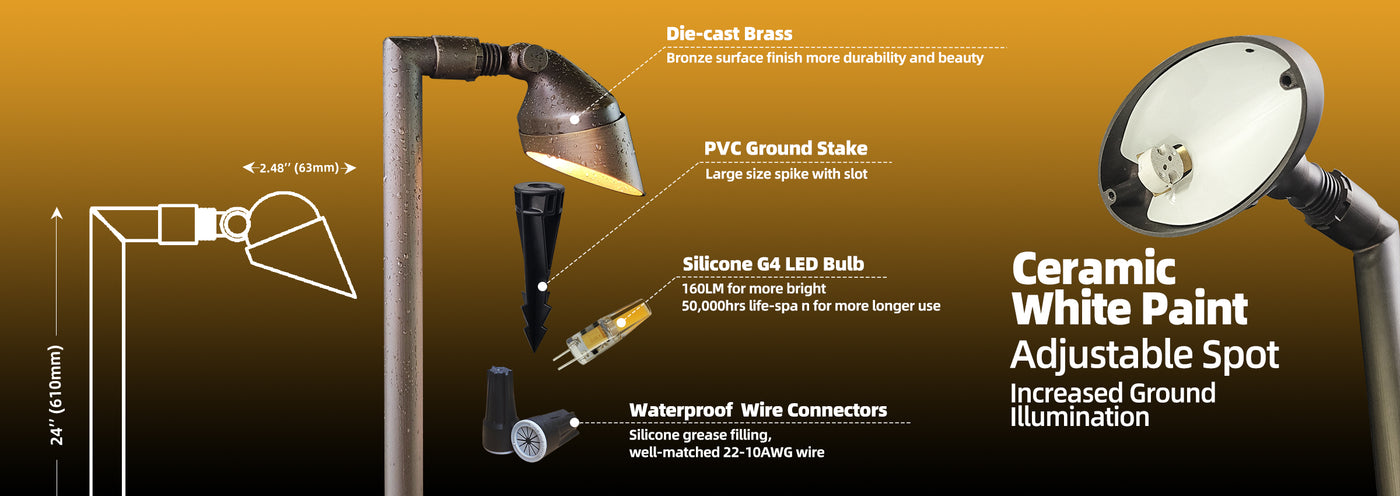


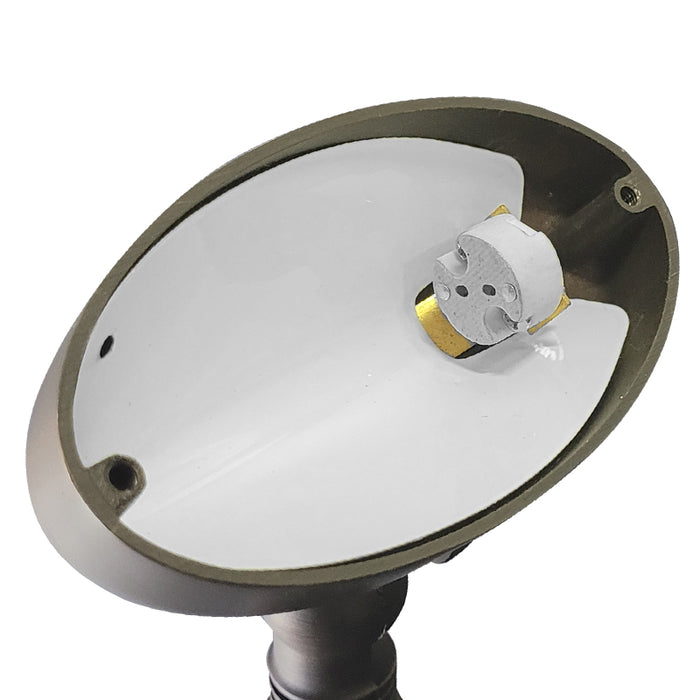
-
What included in the box
-
How long can I receive it
- We have CA/FL two warehouses for service
- We will arrange delivery nearby
- You will receive the goods in 3-5 work days
- Remote areas may take a little longer
-
How long is the warranty
- Brass Fixture: Lifetime
- LED Bulbs: 5 Years
- Stainless Steel Fixture: 3 Years
- Transformers: Lifetime

How to Choose a Suitable Transformer
Low voltage lighting systems require the use of a transformer to reduce the standard 120 volt power from ordinary household electricity to 12,13,14,and 15 volt needed to power low voltage fixtures.
The total wattage of all fixtures connected to one transformer must not exceed the wattage capacity of the transformer.
To determine the size of transformer needed in a low voltage lighting system, add up the wattage of all fixtures in system and then add 10% for low voltage cable and fixtures connections.
If the total load offixtures is too greateither divide the total load between 2 transformers or use a more powerful transformer.
Select a transformer with 20% higher capacity than total wattage of all fixtures in system, that allow you to add more fixtures later.
Product Comparison with Path Lights
| Facet |

MALORY MLR-P02 12V L-Shaped Integrated Brass LED Path Light,Low Voltage Landscape Lighting View details |

Malory MLR-P06 Adjustable Brass LED Path Light,Low Voltage Landscape Path Light (24" High, 180° Rotation) View details | |
|---|---|---|---|
| Price | |||
| Price |
From
$69.69
Unit price
/
Unavailable
|
From
$67.00
Unit price
/
Unavailable
|
From
$79.99
Unit price
/
Unavailable
|

Malory Low Voltage Brass Path Lights FAQ
01 What is different about a directional path light?
Unlike a traditional path light that mainly spreads light downward around the fixture, a directional path light lets you aim the light toward a specific area.
This gives you more control over where the light falls and can be useful along curved paths, planting beds, steps, entrances, or areas where the fixture cannot be installed directly beside the target.
02 What can I use this adjustable path light for?
It works well for:
- walkways
- stepping-stone paths
- planting beds
- garden borders
- driveway edges
- low shrubs
- steps and transitions
- small landscape features
It is especially useful where you want more control over the direction of the light rather than a fixed circular light pattern.
03 Can the light head be adjusted after installation?
Yes. The head can be repositioned to change where the light is aimed.
This makes it easier to fine-tune the lighting after dark, especially if the first daytime placement does not produce the effect you expected.
04 How should I aim the adjustable head?
Aim the head toward the walking surface, planting area, or feature you want to illuminate, while keeping the lamp itself out of normal viewing angles.
A slightly downward angle usually works better than aiming the head horizontally.
After installation, check the fixture while walking toward it from different directions and adjust the angle if the lamp causes glare.
05 Can I aim it across the walkway from the opposite side?
Yes.
One advantage of a directional path light is that the fixture does not always need to sit immediately beside the exact area you want to illuminate.
For example, you can install the fixture in a planting bed and aim the head toward the nearby walkway.
Just make sure the beam does not point directly toward pedestrians or nearby windows.
06 How far apart should directional path lights be?
There is no fixed spacing for every project.
For many residential paths, 8–12 ft can be used as a starting point, but adjustable-head fixtures should be spaced according to the actual light pattern after aiming.
The final spacing depends on:
- head angle
- fixture height
- lamp brightness
- path width
- surrounding plants
- surface color
- desired light overlap
Test several fixtures after dark before finalizing the layout.
07 Does adjusting the head change the illuminated area?
Yes.
Pointing the head more downward generally concentrates the light closer to the fixture.
Aiming it farther outward moves the light pool away from the fixture and may spread the useful illumination over a different area.
Because of this, both fixture position and head angle should be considered when designing the layout.
08 Can this fixture illuminate both the path and nearby plants?
Yes.
This is one of the useful applications of an adjustable path light.
The head can be positioned so that the main light falls on the walkway while some illumination also reaches nearby shrubs, flowers, stone, or mulch.
For taller trees or strong accent lighting, however, a dedicated spotlight or well light is usually more appropriate.
09 Is this a replacement for a spotlight?
Not usually.
Although the head is directional, this type of fixture is still designed primarily for lower-level path and landscape illumination.
Use a spotlight when you need stronger projection toward tall trees, walls, columns, or architectural features.
10 Can I replace the G4 LED lamp?
Yes, if the fixture uses a replaceable G4 lamp.
When replacing it, confirm:
- G4 base
- operating voltage
- wattage
- physical lamp dimensions
- available space inside the head
G4 lamps can vary considerably in size even when the base is the same.
11 Can this path light work with an existing 12V landscape lighting system?
In many cases, yes, provided the fixture and G4 lamp are compatible with the existing transformer output.
Before adding it, confirm:
- transformer output voltage
- AC/DC compatibility
- remaining transformer capacity
- cable gauge
- total connected wattage
12 Where is the best place to install this type of fixture?
Good locations include the edge of a planting bed, beside a curved walkway, near a path intersection, or anywhere you need to direct light toward an area that is slightly offset from the fixture.
Because the head is adjustable, you have more placement flexibility than with a fixed-shade path light.
13 Is this type of fixture good for curved walkways?
Yes.
Directional heads are particularly useful around curves because you can aim the light toward the next section of the path rather than relying only on the fixture's physical position.
14 Should every directional path light point in the same direction?
Not necessarily.
The head angle should respond to the landscape.
Some fixtures may point slightly across the path, others toward a planting bed, and others toward a curve or transition area.
A uniform head angle is less important than achieving a balanced nighttime lighting effect.